Google Ads for Qualified Lead Generation: What Really Makes the Difference
Learn how to structure Google Ads to generate more qualified leads, reduce wasted budget, and turn high-intent searches into business opportunities.
Google Ads can be one of the strongest channels for lead generation, but only when it is built around a clear objective: reaching the right people, at the right moment, with real intent. Many businesses launch campaigns assuming that more clicks will naturally lead to more results. In practice, a strong Google Ads account is not designed to collect traffic. It is designed to create qualified, measurable opportunities for the business.
The difference between a campaign that spends and a campaign that supports growth rarely comes from one setting. It comes from the full system: the keywords selected, the intent behind each search, the quality of the ads, where the traffic lands, the conversion tracking, and the way decisions are reviewed week after week.
The problem: too many businesses buy clicks instead of opportunities
A click has no value if it does not come from someone with a real need. A company can receive hundreds of visitors each month and still fail to generate enough qualified leads. That usually means the campaigns are attracting broad searches, irrelevant requests, or people who are not ready to take action.
For example, a B2B service company may appear for informational searches such as “how to do it yourself” or “free pricing” when it really wants prospects looking for a provider, a quote, or a consultation. Without clear structure, Google Ads can quickly mix very different intentions. That is where budget starts to leak.
The key: understand search intent
Google Ads is powerful because people are already expressing intent. They are looking for a solution, a service, a product, or an answer. But not every intent has the same business value.
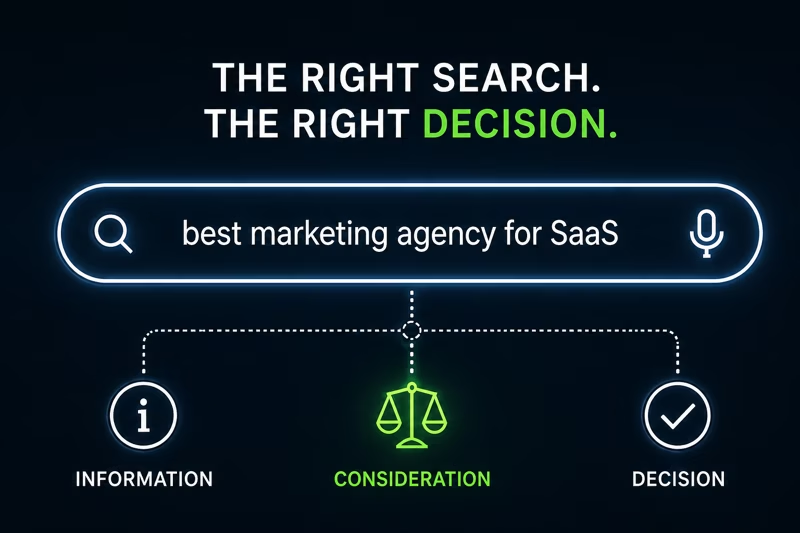
A search like “best commercial cleaning company near me” is very different from “what is commercial cleaning.” The first often points to a more advanced need. The second is educational. Both can matter, but they should not always receive the same budget, ad message, or bidding strategy.
To generate qualified leads, campaigns need to separate high commercial intent, comparison searches, informational searches, branded searches, and irrelevant searches. That segmentation makes the budget work harder.
Strong campaign structure starts with real services
A common mistake is grouping too many services into the same campaign or ad group. The result is generic ad copy, weaker landing page alignment, and data that is hard to interpret.
A better approach is to structure campaigns around business priorities: the primary high-margin service, a secondary service with growth potential, a strategic region, the ideal customer type, or the level of intent. This structure helps answer important questions: which service produces the best leads, which region is too expensive, and which searches lead to real conversations. Without that clarity, optimization is limited.
Ads should qualify before they sell
A good Google ad should not only attract clicks. It should help qualify the prospect before the click happens. If the ad promises something too broad, it will likely attract unqualified visitors. If it is clear about the offer, service area, customer type, or value proposition, it will attract fewer wasted clicks and more relevant inquiries.
Effective ad copy can clarify the service offered, the market served, response expectations, expertise, differentiation, and the action the visitor should take. The goal is not to appeal to everyone. The goal is to attract the right people.
Conversion tracking is non-negotiable
Without reliable tracking, Google Ads becomes difficult to control. A business needs to know how many forms, quote requests, or qualified inquiries come from campaigns. But measurement has to go beyond “form submitted.”
A more useful setup can distinguish a contact form, quote request, booked appointment, qualified lead, or sale. The clearer the data, the better the decisions. A high-performing Google Ads account uses conversion data to learn, filter, prioritize, and optimize.
Lead quality needs to become a core metric
Cost per lead matters, but it does not tell the whole story. An account can reduce cost per lead while producing low-quality inquiries. A more expensive lead can be highly profitable if it matches the right customer profile.
That is why analysis should include cost per lead, conversion rate, qualification rate, services requested, potential customer value, form quality and lead quality, and actual business return. The objective is not always the cheapest lead. The objective is to win the most useful leads at the best possible cost.
Conclusion
Google Ads can generate highly qualified leads, but only when the account is built with a performance system behind it. Clicks are not enough. Impressions are not enough. Even leads are not enough if the quality is weak.
A strong Google Ads strategy depends on intent, structure, tracking, optimization, and clear communication. When the account is built properly, it becomes more than an advertising channel. It becomes a measurable source of business opportunities.